2026/09/29
https://www.music-certification.com/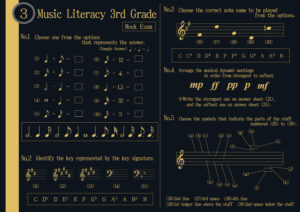
No.1. Choose one from the options that represents the answer.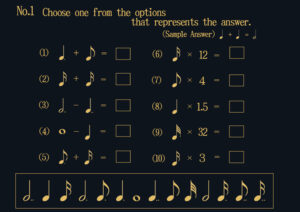
(1) Dotted quarter note + 8th note = Half note (1.5+0.5=2)
(2) 16th note + 16th note = 8th note (0.25+0.25=0.5)
(3) Double dotted half note – Double dotted quarter note = Double dotted quarter note (3-1.5=1.5)
(4) Whole note – Quarter note = Dotted half note (4-1=3)
(5) Dotted 8th note + 16th note = Quarter note (0.75 + 0.25=1)
(6) 16th note × 12 = Dotted half note (0.25×12=3)
(7) 8th note × 4 = Half note (0.5×4=2)
(8) Quarter note × 1.5 = Dotted quarter note (1×1.5=1.5)
(9) 32th note ×32 = Whole note (0.125×32=4)
(10) 16th note × 3 = Dotted 8th note (0.25×3=0.75)
No.2 Identify the key represented by the key signature.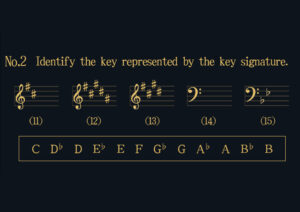
(11) D
The key signature with C♯ and F♯ is D major.
(12) B
The key signature with A♯, C♯, D♯, F♯, and G♯ is B major.
(13) E
The key signature with C♯, D♯, F♯ and G♯ is E major.
(14) C
The key signature with no sharps (♯) or flats (♭) is C major.
(15) B♭
The key signature with B♭ and E♭ is B♭ major.
No.3 Choose the correct note name to be played from the options.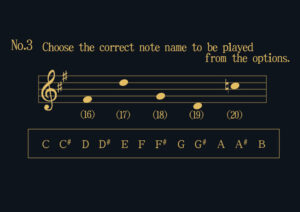
(16) F#
(17) D
(18) G
(19) D
(20) C
No.4 Arrange the musical dynamic markings in order from strongest to softest.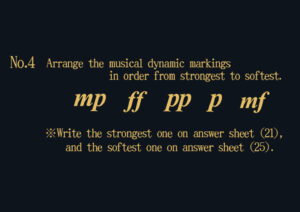
(21) ff
(22) mf
(23) mp
(24) p
(25) pp
Since mezzo piano means “moderately soft,” it is played slightly louder than piano, which means “soft.”
No.5 Choose the symbols that indicate the parts of the staff numbered (26) to (30).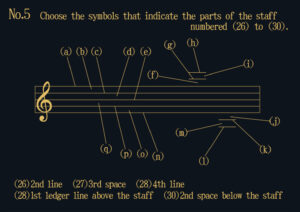
(26) p
(27) d
(28) c
(29) g
(30) m
World Unified Music Certification
Taking the Music Literacy Certification Exam
Mock Exam
Textbook for the Written Exam